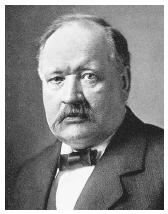
 Svante August Arrhenius (1859-1927) was a Swedish chemist and physicist who received a Nobel prize in chemistry (1903) for his theory of electrolytic dissociation. He hypothesized that once an electrolyte is dissolved into a solvent it would dissociate into oppositely charged ions. Before he even came up with this hypothesis, other chemists believed that electrolytes dissolved as uncharged molecules that could only be separated by strong electric forces. This hypothesis made by Svante Arrhenius explained a wide range of phenomena and laws beyond electrochemistry.
 Arrhenius is mostly known for his equation that describes the effect of temperature on the rate of a reaction:

k = raction rate constant
A = pre-exponential factor
Ea = activation energy
R = gas constant
T = temperature in Kelvin
Arrhenius suggested that the most important step in a chemical reaction was the formation of activated molecules from the reactant molecules and that both states were in equilibrium, separated from each other by the activation energy. He explained how the temperature is dependent of the reaction rate due to a change in equilibrium. As the temperature is increased the molecules that are more activated are set to undergo reaction.

